

Heel
Magnolia Pictures
In a time where society often views justice as leaving a permanent bruise on the reputation and legacy of whoever is deemed worthy of cancellation, the concept of rehabilitation is a conundrum that is often theoretically discussed without weighing the practicality of the concept against social discord and the requirement that society has the ability to move on from past mistakes. While "Cancel Culture", a term that has become so polarized that it feels ineffective to use to describe anything, has led to a rise of accountability for truly evil individuals, the point of removing these abusive forces who weaponized their standing in a position of power has quickly become lost as nearly any mistake or poor decision will result in an immediate backlash with a call for sacrifice and loss. A popular talking point against the modern prison system is its lack of focus on reform and rehabilitation. There is a spoken belief from many of the same individuals who engage with online Cancel Culture that it is better for punishment to focus on reshaping an individual for the better and finding a productive path forward, rather than cutting off their options for a future. However, this is a hypocritical claim of belief from those who also will keep screenshots and reshare accusations, weaponizing even the smallest of mistakes years later without a care for how the individual has grown or changed. These actions are not ones that promote the belief or faith of rehabilitation, instead rejecting it. This is not an easy topic to judge and is one with obvious layers. Saying a possibly derogatory comment on a livestream a decade ago is different from committing systematic rape, and looking at the morality and guilt for every crime on the spectrum is an impossibly large task. However, if there is a line where rehabilitation is believed to be possible and preferred, the process is messy, and there has to be an achievement of grace and forgiveness: something abrasive to modern social media habits.
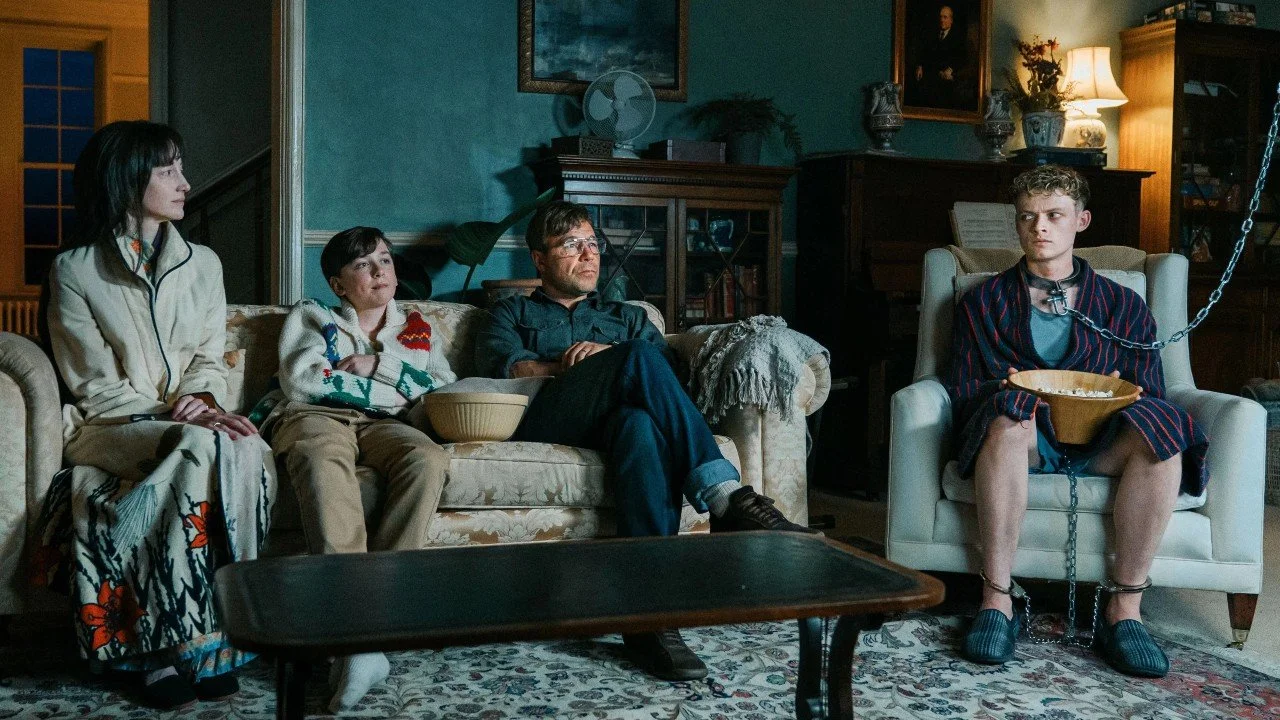
Jan Komasa's Heel follows a family committed to the concept of rehabilitation. Tommy (Anson Boon) is a young man who has caused nothing but chaos and pain as he has terrorized his local community with his friends. From bullying kids on the street to stealing cars and drunk driving, Tommy is on a downward spiral. However, Chris (Stephen Graham) and his family, his wife Kathryn (Andrea Riseborough) and son Jonathan (Kit Rakusen), have decided to help Tommy find enlightenment towards the errors of his ways by kidnapping him and keeping him chained in their basement. While Tommy screams vitriol at them and tries his best to escape, he is forced to remain trapped and undergo lessons about his behavior. Tommy begins to fill his time with books provided by Kathryn, and slowly finds his place within the family.
Forced reform is a concept that has been explored in media before, perhaps most famously in Anthony Burgess' 1962 dystopian novel, A Clockwork Orange, where a young gang leader is given an experimental treatment that causes him to become physically ill at the thought or sight of violence. It is also a concept that Jan Komasa is seemingly obsessed with. Multiple of Komasa's previous films have discussed the concept of reform within a young male protagonist who has found himself on a dark path. Komasa has also expressed a great interest in uneven power dynamics where one takes control over another's life by removing their agency, forcing them on a path they never could choose for themselves. Whether the imbalance of power comes in the form of the fascist government in Anniversary or a stalker in The Hater, Komasa has been circling the same ideas for his entire career, chipping away at conversations far too large for a single film.
Heel takes these concepts and masterfully constructs a screenplay that weaves together these concepts with one of the smartest designs in recent memory. Like Tommy, the audience is thrust into this situation with little context. The film opens with the family hiring a new housekeeper named Rina (Monika Frajczyk). Even before Rina goes into the basement and discovers Tommy, something is off to her. As she talks to Chris, who leads the job interview with the signing of a non-disclosure agreement, she is introduced to his bizarre charm that comes off as almost unnerving, with how performative it feels, largely thanks to Graham's impressive performance that plays against type for the actor. When she talks to Kathryn, she notices how quiet and reserved she is, almost like a ghost slowly wandering the house. Then, of course, there is the boy chained in the basement against his will...
The screenplay, a collaboration between Bartek Bartosik and Naqqash Khalid, never feels the urge to tell the audience what is happening in the world around them. Slowly, the audience and Tommy both begin to pick up on strange details and wrinkles to the family controlling his life. From obscene scratches on a table gifted to him to little slips from Kathryn and Jonathan that hint at a richer past before Tommy entered the picture, the film points to possibilities without ever fully confirming or explaining specific character motivations and family details. Chris and his family have certain moral codes and ideologies that prove there are understandings and plans hidden beneath the surface, pushing viewers to engage further with the text as active participants. While some might be frustrated with the lack of answers, even as the film closes, the promise of there being a larger picture is so well realized and is so engaging that it feels impossible not to get sucked into thinking about every possibility, making Heel a great film for re-watches and further discussion to debate theories and thoughts. This also applies to Tommy, whose home life and individual motivations are equally on display through effective small displays, giving the audience just enough to form an image and understanding.
The morality of the film is equally dynamic for viewers to chew on. Naturally, Chris and his family are in the wrong. They have kidnapped a young man and have held him prisoner. While there are times when Chris feels forced to resort to violence against Tommy, largely the family takes the opposite approach of the prison in A Clockwork Orange, wanting Chris to feel loved and empowered by positive feelings of familial bonds and mutual trust. They do not want Chris to suffer, and at times, both Tommy and the audience can slip under their spell. Tommy, after all, is on a path spiraling towards disaster with no one to help him wake up or steer him in the correct direction. Society has allowed Tommy and those like him to fall without support or guidance, and one has to weigh the intentions of the family looking to help him against the practical extreme action taken. The film does not make this debate easy, often verbalizing just how insane and dehumanizing the family's actions are to Tommy. They have completely removed his agency and humanity, giving him no ability for choice or consent. How do the beliefs of the family differ from the controlling force in Anniversary, which also seeks to force a better tomorrow through the removal of basic rights and liberties? There are a number of contradictions and complications to this power dynamic and conversation, but Komasa is unafraid to embrace them and is the perfect filmmaker to moderate these ideas.
While this skill gives the film an effective and meaningful narrative, it is the performances that truly push the film to the next level. Anson Boon produces the best work of his career, giving a fiery yet emotional delivery that evolves naturally as the runtime continues. This evolution is mirrored in Andrea Riseborough's work, which slowly finds more and more life as her relationship with Tommy grows. Riseborough is purposeful and careful in the reveal of her humanity, building a unique connection to both the audience and Tommy that becomes the emotional bridge between the powerful and the powerless in the displayed dynamic. Together, they begin to discuss literature, and Tommy engages with conversations that challenge him. Through the works of Ray Bradbury and Harper Lee, Tommy is finally treated like an adult and is pushed to have thoughtful conversations on morality, conversations, and intellectual respect he likely has never experienced. Kit Rakusen also gives an unbelievably complex performance for a youth actor, portraying an innocent exterior that has something off about him, leading to a feeling that there is something unspoken within. Both Rakusen and Graham are especially great in this display, speaking to conversations on masculinity and the male projection of both strength and weakness. Still, despite this unsettling edge, Jonathan becomes a vital figure in Tommy's belonging within the family, acting like a brother to Tommy, with the pair forming an organic and heartwarming bond. Despite the rough edges, this family seems to be operating well enough, and as Tommy grows closer and closer to them, another rich cavern of debate opens for the audience as they try to decide how they feel about these characters and the situation provided.
Every character is flawed within Heel. Every character is given at least an allusion to what led them down the troubled road they find themselves on, prompting empathy from the audience. In wrestling with the morality of the situation within the film, the audience also finds itself wrestling with how it is best to address and judge reactions to unfair trauma. While some might find themselves immediately condoning each party, the film displays layers that make it hard to stand by such a brash and simple conclusion. As characters change and evolve, how does the heightened nature of the situation affect the validity of these changes? As Tommy grows closer to the family, is this just Stockholm syndrome setting in, or is it something deeper at work? In a time where social judgment is so damming and final, Heel is a film that promotes more complex thought and engagement.
While Jan Komasa had already made a name for himself as one of the most exciting working filmmakers before this, Heel feels like a definitive step in his career. Bringing together the conversations Komasa has had throughout his filmography into a complex narrative that isn't afraid of challenging the audience and pushing them to think, Komasa delivers his most poignant work to date. The screenplay is flawless, and the film has enough creative decisions in visual design and structure to stand on its own as an artistic statement. It is an absolute shame that, despite a strong reaction from the film's debut at the Toronto International Film Festival last year, Heel was so casually dumped onto VOD, as the film immediately becomes a worthy presence in the conversation for the best films of the year.