

AFI Fest 2026: La Gradiva
2026 AFI Fest
Screening as part of the 2026 AFI Film Festival, Marine Atlan's La Gradiva follows a French high school class that takes a field trip to Italy to explore Naples and see the ruins of Pompeii. On the verge of their high school graduation, the class is both excited and nervous for their next steps into adulthood, trying both to come to terms with what already weighs on their minds and to prepare for whatever comes next. The film travels between students, highlighting multiple of their experiences and struggles on the trip, which grows increasingly tense as the days pass. Included in this lineup is Toni (Colas Quignard) — a troublemaker who uses the trip to try to come to terms with a personal connection to the area, as his grandfather was killed in the 1980 Irpinia earthquake, James (Mitia Capellier-Audat) — Toni's friend who is dealing with complex feelings around intimate connection and relationships, Suzanne (Suzanne Gerin) — Toni's classmate who is trying to understand why she doesn't fit in with others in her class, Madame Mercier (Antonia Buresi) — the teacher who is desperate to get her class to focus on learning about the incredible art and history that is all around them.
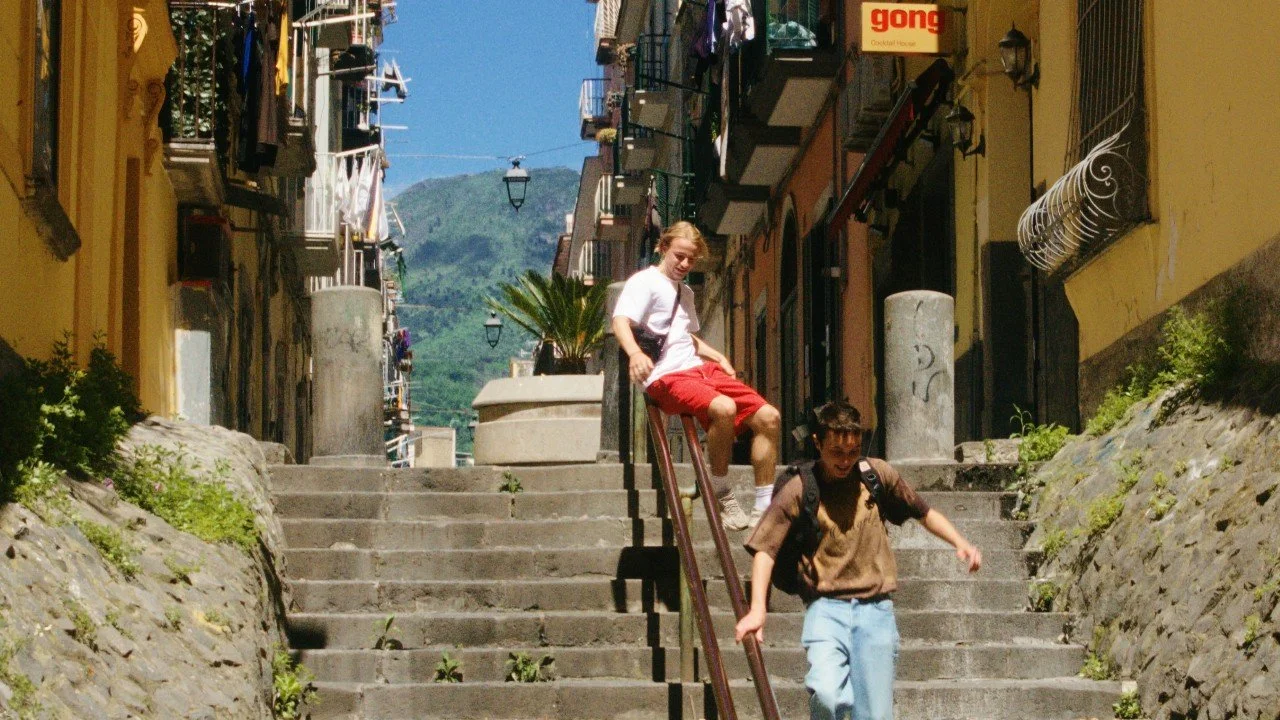
The poetic register of La Gradiva, both in visuals and dialogue, is intoxicating. The film makes the most of its Italian setting, painting the frame with a juxtaposition of historic features and electric youth. The audience feels like they are on the journey alongside the class, walking down the cobblestone pathways of the city, swimming in the bay, and smoking at tiny restaurants where locals have gathered to celebrate a wedding anniversary. There is a striking texture to how the film shoots the class's travels, which is constantly thoughtful in cinematography by Atlan and Pierre W. Mazoyer. Atlan has a deeper history as a cinematographer than she does as a director, which clearly shows in how the film is visually designed, with the visual language of the film working as an active storyteller.
This visual connection between the past and present is further highlighted by the film's screenplay, which elevates the conversation by going deeper into this relationship between time. La Gradiva is a film about acts of geological upheaval. The ancient cities that the class visit are notable because of how the Earth shifted and broke, leaving both profound sadness — such as the loss of Toni's grandfather — and undeniable beauty. Adolescence can behave the same way. Over a few short years, these young humans are forced to react drastically to both physical and emotional changes, with one never sure what day everything will shift. Any force can leave lasting damage, both showcasing the best and worst of what life has to offer. The subjects that La Gradiva focuses on are the individuals who are most vulnerable to this, with their still-forming identities producing confused reactions and messy behavior. The film is a deeply profound look at youth and understanding how complex and lasting the experience can be. The teenage perspective also allows for a diverse range of identities and interpersonal relationships to be fleshed out, with the film offering plenty for the audience to consider and digest with each of its characters as the characters themselves are in the process of understanding who they are. The film shows how profound the experience of travel can be, with new environments bringing out new situations to showcase different sides of who we are. There is no better setup for this type of exploration of youth, with every choice adding to the strengths of the film and its ability.
The only character that doesn't fit this mold exactly is Madame Mercier, who is no longer a teenager and instead has been weathered down by the ebbs and flows of adult life. While Mercier is facing a similar emotional imbalance as the students she teaches, she, as the chaperone of the trip, also acts as a force pushing against her students for better or for worse. While she hopes to enrich the students' experiences and be a force of good, she has her own faults and traumas and cannot be perfect. As the trip progresses, everyone begins to get on everyone's nerves, and pressure increasingly builds. The film is unafraid to be morally complicated, both showing empathy to everyone involved while also never hiding from looking at the consequences that follow directly from their actions. This is a mature angle that is ambitious to try and capture in a single film, but La Gradiva pulls it off. By the end, it is impossible not to be deeply moved by the film, with further thought revealing deeper understandings of each character and the layers of forces that pushed them in the directions they moved. La Gradiva has a habit of sneaking up on the audience. Similar to how the people of Pompeii had no idea that everything was on the verge of ending, the audience isn't always aware of what emotional high or low is just around the corner. The screenplay always feels natural in how it twists, but often catches the audience off-guard with a new, unexpected gut punch.
However, the true magic of the film is not even the incredible work done behind the camera, but rather the work done in front of it. The cast of La Gradiva is one of the best ensembles of the year, with every actor completely melting into their role with a tremendous sense of depth. For the film to be Quignard's first feature is almost unbelievable, with the young actor showing a mature desperation that requires layers of ability. While Toni is a troublemaker, he is also deeply insecure and is desperate for someone to see him and give him the support he needs. Quignard is never overbearing in this, pulling back in a way that feels totally realistic to a young man who doesn't want to let his emotions get away from him. This is especially true in Toni's dynamic with Madame Mercier. While Toni wants to act like he is above caring about his teacher, a key scene comes when she calls him dumb during an argument over his behavior during one of her lectures. Quignard does a fantastic job here, rising with anger that clearly masks his pain from the comment — a pain reinforced by the conversations he tries to avoid with his classmates regarding the future, where he lacks a plan compared to everyone else who seems to have their next steps figured out — before pulling away to not lose control of his emotions. The same inner complexity is found as he hangs out with other boys in his class, with Quignard's performance showing how he is getting tired of how others act irresponsibly, signaling the character's growing maturity. The film doesn't need to explicitly say these developments or explain these layers because Quignard does such an excellent job of bringing them to life naturally.
Capellier-Audat is also quite reserved in his delivery, often sitting in silence as he tries to unravel the feelings of loneliness and dissatisfaction with sexual partners he experiences. James is a prisoner of longing, with the character trying to understand what is missing that is causing him to feel this way. Similar to Quignard, Capellier-Audat has a way of expressing himself that speaks volumes, even when the actual performance is silent. Then, there is Buresi as Madame Mercier. Buresi feels irreplaceable in the role. Whether she is lecturing on the history of a city or caught up in a moment of rage at a misbehaving student, Buresi also brings to life a complicated character who feels fully believable. Buresi is accomplished at making the audience understand that her character is at her breaking point — coming off as both sympathetic to the misbehavior she has to deal with while also being clearly in the wrong for the behaviors she begins to display, such as her fight with Toni, where she insults him. These actors don't feel like they are in a narrative film, but rather feel closer to what one sees in documentary work. It is obvious that there has been deep collaboration between Atlan and each cast member, with every party fully understanding the different sides of what is being brought to life within these characters.
Rarely is a film as thoughtful and clean as La Gradiva. The film’s strength begins with Marine Atlan’s direction and extends through its technical elements, performances, and screenplay. Every piece of the film moves with a masterful synergy, which allows confidence and clarity to be found as the film opens itself up. Because every element of the film is operating at such a high level, the film is able to accomplish a deeply poignant and rich conversation without ever needing to stop itself and explain to the audience what they should be picking up. La Gradiva is sure to be a great film on rewatch, with there being so many relationships to examine and dynamics to chart. To make a film this rich — and then also have it be so artistically beautiful and inviting — is the work of someone truly special. La Gradiva is, without a doubt, one of the finest films of the year and is a gem that deserves to be discovered.