

Ha-Chan, Shake Your Booty!
Sony Pictures Classic
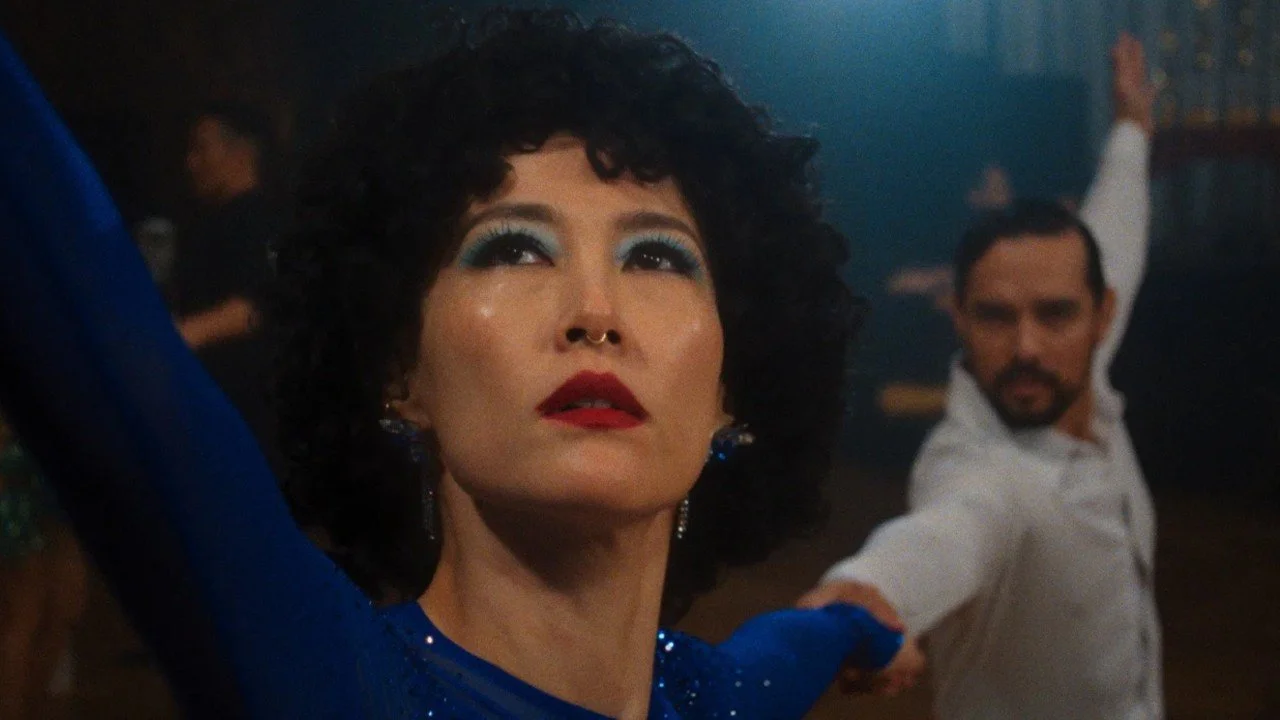
There has long been a connection between suffering and art. Whether being used as a form of catharsis to express one's suffering or as a tool to push it into the background and move on, art is a tool used to combat pain. In Josef Kubota Wladyka's Ha-Chan, Shake Your Booty!, this is the case for Haru (Rinko Kikuchi) when she pushes herself to attend a dance class months after the sudden death of her husband, Luis (Alejandro Edda). Haru loved to dance and competed alongside Luis in competitions up until the moment he tragically died during a routine. In the months since Luis' death, Haru has worn her dancing costume, but has not been able to bring herself to dance or move on from her suffering. She sits in isolation, sometimes seeing Luis' ghost, until her friends help her back to her feet and get her back to the dance studio where a young instructor named Fedir (Alberto Guerra) teaches. The pair immediately have a spark, and despite being married, Fedir pursues Haru, aligned with his relationship's open status. While the connection brings Haru a new pep in her step, she still cannot get over the visions of her dead husband, and the complex emotions that are forming towards Fedir, who is clear that he is committed to his wife and doesn't want anything deeper than some fun.
From its opening moments, Ha-Chan, Shake Your Booty! is the equivalent of a snowball being pushed off the top of a mountain, growing in size and destruction as it picks up speed on its descent to the bottom. The film opens with a radiant sense of happiness. Haru has found a life she loves, with a husband and dog that bring her joy. Daniel Satinoff's cinematography is light and energetic, using dynamic zooms to capture the smiles and moments of intimacy shared between the pair. The film is not afraid to embrace the abstract, bringing the inner emotions of its characters to the outer world. As Haru and Luis dance, they begin to float into the sky, soaring from their physical embrace. Tragedy, however, brings them crashing back to the ground.
The grief felt by Haru is a gut punch. Kikuchi is perfection in her portrayal of a woman powerless against her grief. After the death of Luis, the film cuts 8 months forward to Haru's friends preparing to surprise her for her birthday. Haru never attends this party, opting instead to stay alone at her house, trying to replicate the life she lost. She still cooks for Luis, sits at the table with his empty space staring her down, and, most importantly, is visited by him. Haru often sees Luis wearing a giant black bird costume, wandering the house, watching her and reminding her of the life she cannot have. Haru has found herself stagnant and rotting. Even when she is pushed out of the house by her friends, Hiromi (You) and Yuki (Yoh Yoshida), and she begins to form a new relationship with Fedir, this ghost haunts her. Even as the film and Haru's life begin to move on, the physical presence of Luis acts as a chain to the pain she has not dealt with. It is a stark reminder that in life, there is no easy answer for one to avoid confronting their suffering. It only gets tougher for Haru as her perception of Luis' ghost changes once she is with Fedir — growing sad at what he is seeing, becoming a physical manifestation of Haru's guilt and inner struggle.
Even though the film is consistently tied to tragedy, it cannot be overstated how much fun the film also has, with the two emotional poles never pulling the film apart as it travels between them. You enters the picture as a breath of fresh air, offering no hesitation as she yells at Haru that she needs to get back on her feet. There is a natural charisma to the actress that is not only infectious, but plays wonderfully off the more subdued Yoshida, who never has the same level of boldness in her attempts to help Haru. The film supports this tonal shift in its screenplay. The film is split between multiple chapters, each carrying its own fun identity and title. The comedic timing throughout the film is skillful, knowing how to push a joke to the furthest it can go without growing old, and mastering the concept of a comedic payoff.
As Haru gets further and further involved with Fedir, things grow messy in a way that is ripe for entertainment. Fedir is clear about his expectations, never promising Haru anything more than being friends with benefits. Haru blasts through these barriers, forming an intimate relationship with Fedir, who never holds too much resistance. The pair not only have sex, but also enjoy dates, such as a trip to a local theater's stage adaptation of Emile Ardolino's Dirty Dancing, and spend long nights together discussing a range of topics. Haru hides that her husband is dead, again trying to shove the tragedy of the event under the rug and simply live in the present.
The film portrays this relationship with careful nuance. As things grow out of control, the film isn't interested in unwinding fault or pointing complete blame on either party. While Haru is dealing with things in a manner that is obviously unhealthy, the film also acknowledges Fedir's complicity in letting Haru fall for him. This complexity is heightened by Guerra's performance that transforms under the different lights Fedir is put under as a character, crafting a performance that feels like a living complexity rather than a hollow figure who is written to be more layered than he actually appears. Rather than concerning itself with the debate of Haru and Fedir's relationship, the film offers a wide acknowledgment that life is messy. No matter how careful one is with emotions and relationships, things are guaranteed to fall off the rails at some point, which the film argues should be celebrated as the flavor of the human experience rather than a defect of it. If one acknowledges this and pushes to accept the ups and downs that it brings, one can even possibly learn to authentically dance again even after seismic tragedy erupts in their life.
There are extra flavors of richness sprinkled throughout the film. Dedicated to the director’s mother, the film also functions as a celebration of love and multiculturalism. The film is an empowering one about the resilience of women and is a love letter to the support they share with others. Even if the film centers on a fictionalized story, the core is something deeply real, and the personal touches from the director serve as an extra garnish to enjoy and fill out the film and its world. Ha-Chan, Shake Your Booty! is a beautiful film, delivering a final performance that takes the audience on a worthy journey of processing trauma and finding the joy in the life that comes after. There is tremendous fun to be had with the film, but there is also an incredible power to the piece, making it one of the year’s best portrayals of grief.