

The End of Oak Street
Warner Bros. Pictures
Few filmmakers have proved to be as eccentric so early in their careers as David Robert Mitchell. Jumping not only between multiple genres but also various levels of artistic depth, no one would naturally be able to piece together that the filmmaker who brought clever horror film It Follows would be the same one to make the experimental reflection on Los Angeles that is Under the Silver Lake. With each change, Mitchell offers a new display of his ability, proving to have a wide range of talents. Continuing to roll the dice with his cinematic focus, Mitchell returns to the big screen with The End of Oak Street.
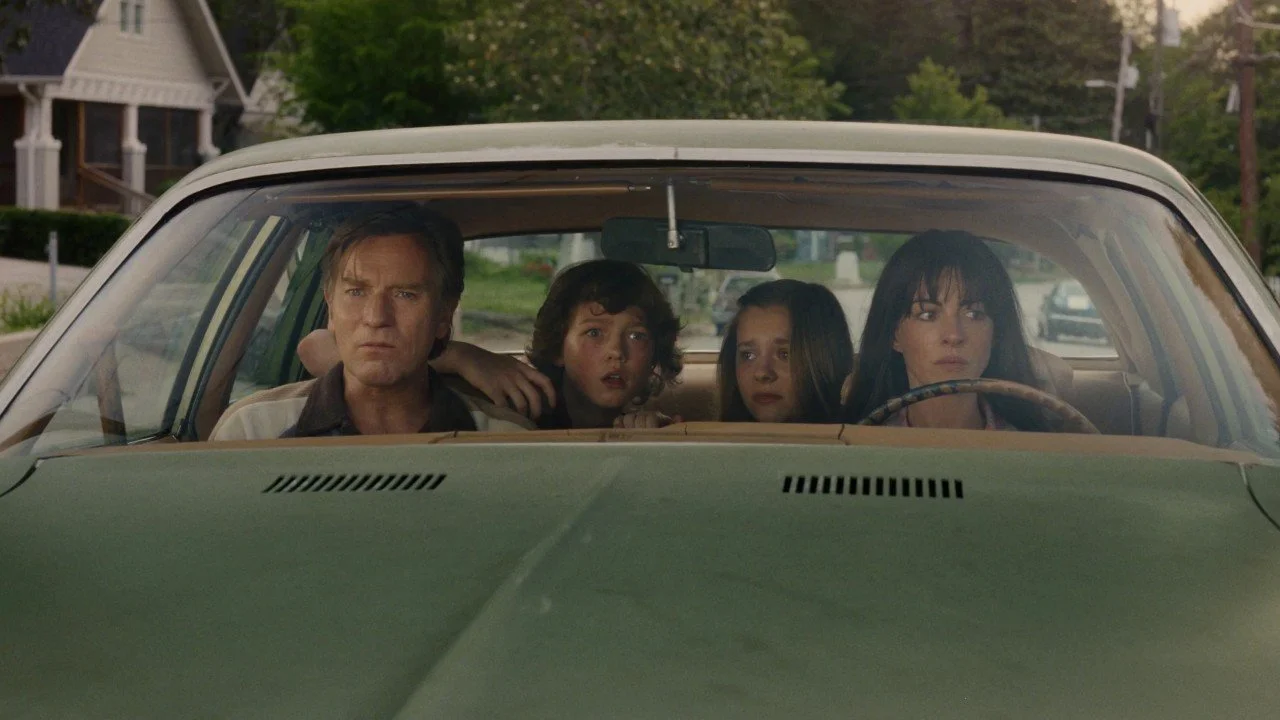
The film opens on a seemingly regular family in the summer of 1982, outside of the marital issues brewing between husband Greg (Ewan McGregor) and wife Denise (Anne Hathaway), enjoying block parties and arguing with neighbors over the behavior of their dog Starbuck (Brisket) with their son Brian (Christian Convery) and daughter Audrey (Maisy Stella). While small anomalies begin to happen around the neighborhood, like a prehistoric plant growing in a neighbor's backyard, things seem quite normal. One night during a major storm, a flash of light appears, and the electricity and water get cut from the house. At first, the family thinks this is just a normal blackout, but when morning comes, the truth of their situation is revealed, as it turns out their entire neighborhood has been teleported to the Mesozoic Era, meaning they now have to survive as the dinosaurs move in.
Despite the financial success of the Jurassic Park franchise, it is strange to see how few filmmakers take advantage of having dinosaurs be a part of their films. While there is the occasional original release like 65 or Primitive War, most modern cinematic portrayals of dinosaurs see the creatures used in supporting roles in children's animated projects such as The Super Mario Galaxy Movie or PAW Patrol: The Dino Movie. Even the long-running The Land Before Time animated series of dinosaur films called it quits in 2016 after a whopping 14 films. While there has been a quiet resurgence of informative Dinosaur television projects, including Apple TV+'s Prehistoric Planet and Netflix's The Dinosaurs, the narrative output of dinosaur projects remains lacking. This is perhaps one of the reasons that The End of Oak Street feels so refreshing.
Even for those who have kept up with the recent limited dinosaur content, The End of Oak Street feels quite innovative in its selection and use of dinosaurs, offering enough changes to traditionally seen dinosaur iconography to feel unique. While the film echoes the modern Jurassic World problem of committing to CGI dinosaurs instead of practical effects, even when certain close-up scenes would have been far more effective with a tangible creature, the visual effects are strong enough to never feel cheap or distracting. The film has a tremendous amount of fun as it revels in its prehistoric threats, drawing out extended sequences of tension in a way that generates enjoyment from the audience as they are clued into the dangers that the characters are in before they are ever aware. There are multiple sequences where the audience will see a dinosaur in the background notice an unaware character being focused on. The film will stick with that shot, as the audience sees the threat approach until, at the very last second, the character becomes aware and either has to fight or run. The film is playful with these perspectives, relishing its characters' suffering. For those worried that the film will play it overly safe, there are a handful of sequences that feel genuinely shocking with how far they are willing to go, as dumb choices sometimes prove to have tragic consequences.
To make this tonally work, the film plays into the absurdity of its characters' actions, making each lose their intelligence as they try to survive their new reality. Sadly, Sam Neill's warning about not drawing attention to yourself by yelling in Jurassic Park III missed these characters by a couple of decades, as everyone spends their time outside screaming and making themselves known. There are times where the stupidity of characters feels too unnatural; a key push to conflict sees Brian break out of his house one night to wander around the dinosaur-infested streets to find a missing Starbuck, but the film makes it clear that it isn't taking its writing too seriously, so it never asks the audience to either.
The biggest notable area where this lack of logic feels detracting doesn't come from how the film's main family reacts, but rather how the rest of the neighborhood handles their survival. While Brian's disappearance gives a catalyst for his family to venture into the night, apparently the entire neighborhood doesn't see the value of hiding or staying alive as they continually run around the neighborhood like chickens with their heads cut off. Considering the circumstances, it comes off as bizarrely silly that small dramas such as a neighborhood teenager wanting revenge on Billy for breaking his brother's arm would still be a relevant concern. This writing feels unnatural, and it does feel like the film had an opening for a stronger sense of societal evolution as individuals must become selfish in order to survive. The film has a single conversation where it feels genuinely concerned with the practicality of the situation, as the family gathers to discuss their game plan of survival and comment on their lack of resources. This drama is never mentioned again, with the story resolving itself rather quickly before these long-term concepts actually become difficult problems for the family.
The technical filmmaking is arguably the film's strongest aspect. Mitchell and regular cinematography collaborator Mike Gioulakis have a tremendous amount of fun with the film's production, using a visual language not often seen in films of this size. There are multiple split diopter shots, and every camera movement feels intentional as the film has a number of effective long takes that highlight the scope of action sequences. In the best of ways, The End of Oak Street feels like a film made 30 years ago, further proving Mitchell's ability as a filmmaker and serving as another reminder for modern cinema that style doesn't have to be dead. Between this and Steven Spielberg's Disclosure Day, another film to embrace a playful camera and visual identity, 2026 is shaping up to be a return to form for the look of blockbuster cinema, and one has to hope this blossoms into more big-budget films in the future as a response to just how visually dull and lacking that level of filmmaking has become over the last decade.
The cast is also a strength, with Hathaway arguably giving the best performance of her stacked year of releases. Hathaway is easily given the biggest emotions and largest arc of the film, starting the film as a disillusioned mother dreaming of escaping her life. Every night in secret, Denise goes to the basement and works on her book, pouring her real emotions into a fictionalized character to try and cope for another day. The only person she shares her work with is her elderly neighbor, Mrs. Huddleston (Anne Gee Byrd), whose encouragement brings Denise to tears. When the dinosaurs take over, the basement floods, destroying both her writing and her focus on escaping, instead having to rise as a pillar of direction and support for her family. While Denise begins the film feeling like she lacks the courage and power to even get a divorce, she quickly has to rise into the role of action hero to protect her kids. McGregor plays nicely off of Hathaway, portraying a sympathetic yet lousy husband who has retreated from his family, whom he is working hard to care for. Constantly leaving to deliver pizza for extra cash, Greg is never a villainous character, but is so blind he cannot see how he is failing to be there for his wife. This is a complex role to pull off, but McGregor nails it. Both Convery and Stella round out the family dynamic well, with Stella especially giving moments of substance as she internalizes her role growing up and tries to take on more responsibility, but neither kid is given an arc or thought as fleshed out as their parents.
The End of Oak Street is the perfect sweet treat to end the summer movie season with. While expectations should be set for the film ultimately being a popcorn flick that is more concerned with having fun than ever being intelligent, it is hard not to get lost in the fun of the experience. This is a great piece of adult dinosaur cinema, with its release weekend being perhaps the first time in history that two great dinosaur films are released, one for two completely different age demographics.